
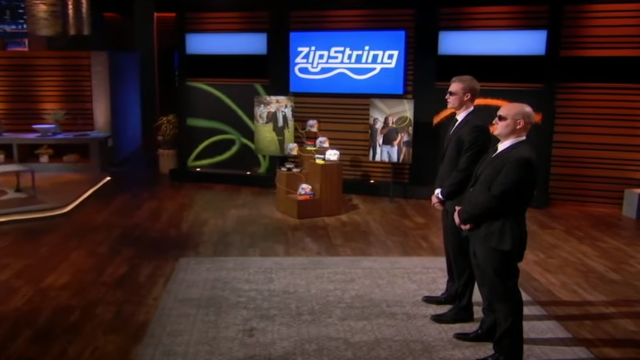
ZipString Update | Shark Tank Season 14
Stephen Fazio and Austin Hillam identified a way to turn a unique “string shooter” concept into an engaging product that captivates users, leading them to develop ZipString. This handheld gadget spins a loop of string, allowing users to perform mesmerizing tricks and movements, providing endless fun for beginners and advanced users alike. Will the sharks offer them a deal? Let’s unravel the details in our ZipString update and pitch recap.
If you’re short on time, here’s a quick overview of what happened to ZipString after
Austin and Stephen pitched their string toy business on
In terms of a ZipString update, the company sold out its inventory within minutes of airing. Further, they addressed early fulfillment challenges by mid-2023 and expanded their product line with ZipString Luma, a glow-in-the-dark version.
| Shark | Result |
| Robert Herjavec and Kevin O’Leary | Accepted offer of $100,000 for 20% equity |
| Barbara Corcoran | No offer |
| Lori Greiner | No offer |
| Mark Cuban | No offer |
Shark Tank ZipString Pitch

- Entrepreneurs: Austin Hillam and Stephen Fazio
- Business: String Toy
- Ask: $100,000 for 10% equity
- Result: $100,000 for 20% equity
- Sharks: Robert Herjavec and Kevin O’Leary
Austin and Stephen kicked off their pitch by showcasing ZipString, a toy they proudly called “the toy of the future.”

The sharks use their samples of ZipString, and they all think it’s pretty cool.
They explained to the sharks that they needed investment to scale manufacturing and meet the overwhelming demand sparked by their viral social media success.
ZipString is a device that propels a string safely at 35 miles per hour, allowing users to perform various tricks.
In addition, the business gained significant attention after a social media video showcasing the toy went viral, earning over 20 million views in a single day.
However, despite this success, the company faced challenges with manufacturing and supply chain issues, limiting its ability to meet high demand.
Despite these obstacles, the team sold over 10,000 units at an average price of $25, generating $277,000 in total sales.
Each ZipString unit costs $6.35 to produce, with the potential to reduce costs to $5.87 with increased volume.
Barbara Corcoran and Kevin O’Leary expressed concerns about the pricing, while Robert Herjavec disagreed and saw potential for scale.
The company launched a successful Kickstarter campaign that raised $90,466 in October 2021.
This momentum helped them address production challenges and improve operations.
Moreover, the product appeals to children, teenagers, and adults who enjoy skill-based toys. With production issues resolved, the entrepreneurs are ready to scale their operations.
Kevin expressed interest but was concerned about the cost structure and long-term competitiveness.
He offered $100,000 for a $1 royalty per unit in perpetuity with no equity.
Lori Greiner felt the product was too early in its lifecycle for her to invest and decided to opt out.
Barbara believed the product didn’t align with her expertise and also opted out.
Robert disagreed with the pricing concerns and saw potential for scale. He offered $100,000 for 20% equity, believing in their ability to grow.
Similarly, Mark Cuban felt the product’s appeal would fade over time and didn’t see a long-term market for it, so he passed on the opportunity.
Kevin, eager to stay competitive, revised his offer to $100,000 for 15% equity, while Robert countered by reducing his offer to $100,000 for 10% equity.
After some back-and-forth, Kevin suggested teaming up with Robert. Together, they proposed $100,000 for 20% equity, splitting it equally at 10% each.
Stephen and Austin attempted to negotiate for 15%, but Kevin and Robert held firm.
Fearing they might lose the deal, the entrepreneurs accepted the joint offer of $100,000 for 20% equity.
Was this a good deal for the entrepreneurs? Let’s find out in our ZipString update.
Shark Tank ZipString Update
Our ZipString update found that there is no confirmation that the deal with Kevin O’Leary and Robert Herjavec was finalized.
Nonetheless, shortly after airing, they sold out within minutes.
Operating from their workspace in Johns Creek, Georgia, Stephen and Austin worked tirelessly to fulfill backorders and manage customer expectations.
By mid-2023, they resolved earlier fulfillment issues and introduced ZipString Luma, a glow-in-the-dark version of their product.
However, our ZipString update found that the company has faced challenges from knockoff products entering the market, which impacted their sales momentum.
Since
We’re calling this ZipString update a success and can’t wait to see what the future holds.
For more updates on companies from
Before you go, check out our Shark Tank Season 14 page for more updates.

Andrew is a lifelong fan of Shark Tank and an entrepreneur at heart. He started Shark Tank Recap because he wanted a single place to track what happens to the companies, founders, and deals after they air on TV. With a sharp eye for business insights and a passion for all things Shark Tank, Andrew makes sure every recap is accurate, engaging, and fun.
- Andrew Smith
- Andrew Smith
- Andrew Smith
- Andrew Smith
- Andrew Smith
- Andrew Smith
- Andrew Smith
- Andrew Smith
- Andrew Smith
- Andrew Smith
- Andrew Smith
- Andrew Smith
- Andrew Smith
- Andrew Smith
- Andrew Smith
- Andrew Smith
- Andrew Smith
- Andrew Smith
- Andrew Smith
- Andrew Smith
- Andrew Smith
- Andrew Smith
- Andrew Smith
- Andrew Smith
- Andrew Smith
- Andrew Smith
- Andrew Smith
- Andrew Smith
- Andrew Smith
- Andrew Smith
- Andrew Smith
- Andrew Smith
- Andrew Smith
- Andrew Smith
- Andrew Smith
- Andrew Smith
- Andrew Smith
- Andrew Smith
- Andrew Smith
- Andrew Smith
- Andrew Smith
- Andrew Smith
- Andrew Smith
- Andrew Smith
- Andrew Smith
- Andrew Smith
- Andrew Smith
- Andrew Smith
- Andrew Smith
- Andrew Smith
- Andrew Smith
- Andrew Smith
- Andrew Smith
- Andrew Smith
- Andrew Smith
- Andrew Smith
- Andrew Smith
- Andrew Smith
- Andrew Smith
- Andrew Smith
- Andrew Smith
- Andrew Smith
- Andrew Smith
- Andrew Smith
- Andrew Smith
- Andrew Smith
- Andrew Smith
- Andrew Smith
- Andrew Smith
- Andrew Smith
- Andrew Smith
- Andrew Smith
- Andrew Smith
- Andrew Smith
- Andrew Smith
- Andrew Smith
- Andrew Smith
- Andrew Smith
- Andrew Smith
- Andrew Smith
- Andrew Smith
- Andrew Smith
- Andrew Smith
- Andrew Smith
- Andrew Smith
- Andrew Smith
- Andrew Smith
- Andrew Smith
- Andrew Smith
- Andrew Smith
- Andrew Smith
- Andrew Smith
- Andrew Smith
- Andrew Smith
- Andrew Smith
- Andrew Smith
- Andrew Smith
- Andrew Smith
- Andrew Smith
- Andrew Smith
- Andrew Smith
- Andrew Smith
- Andrew Smith
- Andrew Smith
- Andrew Smith
- Andrew Smith
- Andrew Smith
- Andrew Smith
- Andrew Smith
- Andrew Smith
- Andrew Smith
- Andrew Smith
- Andrew Smith
- Andrew Smith
- Andrew Smith
- Andrew Smith
- Andrew Smith
- Andrew Smith
- Andrew Smith
- Andrew Smith
- Andrew Smith
- Andrew Smith
- Andrew Smith
- Andrew Smith
- Andrew Smith
- Andrew Smith
- Andrew Smith
- Andrew Smith
- Andrew Smith
- Andrew Smith
- Andrew Smith
- Andrew Smith
- Andrew Smith
- Andrew Smith
- Andrew Smith
- Andrew Smith
- Andrew Smith
- Andrew Smith
- Andrew Smith
- Andrew Smith
- Andrew Smith
- Andrew Smith
- Andrew Smith
- Andrew Smith
- Andrew Smith
- Andrew Smith
- Andrew Smith
- Andrew Smith
- Andrew Smith
- Andrew Smith
- Andrew Smith
- Andrew Smith
- Andrew Smith
- Andrew Smith
- Andrew Smith
- Andrew Smith
- Andrew Smith
- Andrew Smith
- Andrew Smith
- Andrew Smith
- Andrew Smith
- Andrew Smith
- Andrew Smith
- Andrew Smith
- Andrew Smith
- Andrew Smith
- Andrew Smith
- Andrew Smith
- Andrew Smith
- Andrew Smith
- Andrew Smith
- Andrew Smith
- Andrew Smith
- Andrew Smith
- Andrew Smith
- Andrew Smith
- Andrew Smith
- Andrew Smith
- Andrew Smith
- Andrew Smith
- Andrew Smith
- Andrew Smith
- Andrew Smith
- Andrew Smith
- Andrew Smith
- Andrew Smith
- Andrew Smith
- Andrew Smith
- Andrew Smith
- Andrew Smith
- Andrew Smith
- Andrew Smith
- Andrew Smith
- Andrew Smith
- Andrew Smith
- Andrew Smith
- Andrew Smith
- Andrew Smith
- Andrew Smith
- Andrew Smith
- Andrew Smith
- Andrew Smith
- Andrew Smith
- Andrew Smith
- Andrew Smith
- Andrew Smith
- Andrew Smith
- Andrew Smith
- Andrew Smith
- Andrew Smith
- Andrew Smith
- Andrew Smith
- Andrew Smith
- Andrew Smith
- Andrew Smith
- Andrew Smith
- Andrew Smith
- Andrew Smith
- Andrew Smith
- Andrew Smith
- Andrew Smith
- Andrew Smith
- Andrew Smith
- Andrew Smith
- Andrew Smith
- Andrew Smith
- Andrew Smith
- Andrew Smith
- Andrew Smith
- Andrew Smith
- Andrew Smith
- Andrew Smith
- Andrew Smith
- Andrew Smith
- Andrew Smith
- Andrew Smith
- Andrew Smith
- Andrew Smith
- Andrew Smith
- Andrew Smith
- Andrew Smith
- Andrew Smith
- Andrew Smith
- Andrew Smith
- Andrew Smith
- Andrew Smith
- Andrew Smith
- Andrew Smith
- Andrew Smith
- Andrew Smith
- Andrew Smith
- Andrew Smith
- Andrew Smith
- Andrew Smith
- Andrew Smith
- Andrew Smith
- Andrew Smith
- Andrew Smith
- Andrew Smith
- Andrew Smith
- Andrew Smith
- Andrew Smith
- Andrew Smith
- Andrew Smith
- Andrew Smith
- Andrew Smith
- Andrew Smith
- Andrew Smith
- Andrew Smith
- Andrew Smith
- Andrew Smith
- Andrew Smith
- Andrew Smith
- Andrew Smith
- Andrew Smith
- Andrew Smith
- Andrew Smith
- Andrew Smith
- Andrew Smith
- Andrew Smith
- Andrew Smith
- Andrew Smith
- Andrew Smith
- Andrew Smith
- Andrew Smith
- Andrew Smith
- Andrew Smith
- Andrew Smith
- Andrew Smith
- Andrew Smith
- Andrew Smith
- Andrew Smith
- Andrew Smith
- Andrew Smith
- Andrew Smith
- Andrew Smith
- Andrew Smith
- Andrew Smith
- Andrew Smith
- Andrew Smith
- Andrew Smith
- Andrew Smith
- Andrew Smith
- Andrew Smith
- Andrew Smith
- Andrew Smith
- Andrew Smith
- Andrew Smith
- Andrew Smith
- Andrew Smith
- Andrew Smith
- Andrew Smith
- Andrew Smith
- Andrew Smith
- Andrew Smith
- Andrew Smith
- Andrew Smith
- Andrew Smith
- Andrew Smith
- Andrew Smith
- Andrew Smith
- Andrew Smith
- Andrew Smith
- Andrew Smith
- Andrew Smith
- Andrew Smith
- Andrew Smith
- Andrew Smith
- Andrew Smith
- Andrew Smith
- Andrew Smith
- Andrew Smith
- Andrew Smith
- Andrew Smith
- Andrew Smith
- Andrew Smith
- Andrew Smith
- Andrew Smith
- Andrew Smith
- Andrew Smith
- Andrew Smith
- Andrew Smith
- Andrew Smith
- Andrew Smith
- Andrew Smith
- Andrew Smith
- Andrew Smith
- Andrew Smith
- Andrew Smith
- Andrew Smith
- Andrew Smith
- Andrew Smith
- Andrew Smith
- Andrew Smith
- Andrew Smith
- Andrew Smith
- Andrew Smith
- Andrew Smith
- Andrew Smith
- Andrew Smith
- Andrew Smith
- Andrew Smith
- Andrew Smith
- Andrew Smith
- Andrew Smith
- Andrew Smith
- Andrew Smith
- Andrew Smith
- Andrew Smith
- Andrew Smith
- Andrew Smith
- Andrew Smith
- Andrew Smith
- Andrew Smith
- Andrew Smith
- Andrew Smith
- Andrew Smith
- Andrew Smith
- Andrew Smith
- Andrew Smith
- Andrew Smith
- Andrew Smith
- Andrew Smith
- Andrew Smith
- Andrew Smith
- Andrew Smith
- Andrew Smith
- Andrew Smith
- Andrew Smith
- Andrew Smith
- Andrew Smith
- Andrew Smith
- Andrew Smith
- Andrew Smith
- Andrew Smith
- Andrew Smith
- Andrew Smith
- Andrew Smith
- Andrew Smith
- Andrew Smith
- Andrew Smith
- Andrew Smith
- Andrew Smith
- Andrew Smith
- Andrew Smith
- Andrew Smith
- Andrew Smith
- Andrew Smith
- Andrew Smith
- Andrew Smith
- Andrew Smith
- Andrew Smith
- Andrew Smith
- Andrew Smith
- Andrew Smith
- Andrew Smith
- Andrew Smith
- Andrew Smith
- Andrew Smith
- Andrew Smith
- Andrew Smith
- Andrew Smith
- Andrew Smith
- Andrew Smith
- Andrew Smith
- Andrew Smith
- Andrew Smith
- Andrew Smith
- Andrew Smith
- Andrew Smith
- Andrew Smith
- Andrew Smith
- Andrew Smith
- Andrew Smith
- Andrew Smith
- Andrew Smith
- Andrew Smith
- Andrew Smith
- Andrew Smith
- Andrew Smith
- Andrew Smith
- Andrew Smith
- Andrew Smith
- Andrew Smith
- Andrew Smith
- Andrew Smith
- Andrew Smith
- Andrew Smith
- Andrew Smith
- Andrew Smith
- Andrew Smith
- Andrew Smith
- Andrew Smith
- Andrew Smith
- Andrew Smith
- Andrew Smith
- Andrew Smith
- Andrew Smith
- Andrew Smith
- Andrew Smith
- Andrew Smith
- Andrew Smith
- Andrew Smith
- Andrew Smith
- Andrew Smith
- Andrew Smith
- Andrew Smith
- Andrew Smith
- Andrew Smith
- Andrew Smith
- Andrew Smith
- Andrew Smith
- Andrew Smith
- Andrew Smith
- Andrew Smith
- Andrew Smith
- Andrew Smith
- Andrew Smith
- Andrew Smith
- Andrew Smith
- Andrew Smith
- Andrew Smith
- Andrew Smith
- Andrew Smith
- Andrew Smith
- Andrew Smith
- Andrew Smith
- Andrew Smith
- Andrew Smith
- Andrew Smith
- Andrew Smith
- Andrew Smith
- Andrew Smith
- Andrew Smith
- Andrew Smith
- Andrew Smith
- Andrew Smith
- Andrew Smith
- Andrew Smith
- Andrew Smith
- Andrew Smith
- Andrew Smith
- Andrew Smith
- Andrew Smith
- Andrew Smith
- Andrew Smith
- Andrew Smith
- Andrew Smith
- Andrew Smith
- Andrew Smith
- Andrew Smith
- Andrew Smith
- Andrew Smith
- Andrew Smith
- Andrew Smith
- Andrew Smith
- Andrew Smith
- Andrew Smith
- Andrew Smith
- Andrew Smith
- Andrew Smith
- Andrew Smith
- Andrew Smith
- Andrew Smith
- Andrew Smith
- Andrew Smith
- Andrew Smith
- Andrew Smith
- Andrew Smith
- Andrew Smith
- Andrew Smith
- Andrew Smith
- Andrew Smith
- Andrew Smith
- Andrew Smith
- Andrew Smith
- Andrew Smith
- Andrew Smith
- Andrew Smith
- Andrew Smith
- Andrew Smith
- Andrew Smith
- Andrew Smith
- Andrew Smith
- Andrew Smith
- Andrew Smith
- Andrew Smith
- Andrew Smith
- Andrew Smith
- Andrew Smith
- Andrew Smith
- Andrew Smith
- Andrew Smith
- Andrew Smith
- Andrew Smith
- Andrew Smith
- Andrew Smith
- Andrew Smith
- Andrew Smith
- Andrew Smith
- Andrew Smith
- Andrew Smith
- Andrew Smith
- Andrew Smith
- Andrew Smith
- Andrew Smith
- Andrew Smith
- Andrew Smith
- Andrew Smith
- Andrew Smith
- Andrew Smith
- Andrew Smith
- Andrew Smith
- Andrew Smith
- Andrew Smith
- Andrew Smith
- Andrew Smith
- Andrew Smith
- Andrew Smith
- Andrew Smith
- Andrew Smith
- Andrew Smith
- Andrew Smith
- Andrew Smith
- Andrew Smith
- Andrew Smith
- Andrew Smith
- Andrew Smith
- Andrew Smith
- Andrew Smith
- Andrew Smith
- Andrew Smith
- Andrew Smith
- Andrew Smith
- Andrew Smith
- Andrew Smith
- Andrew Smith
- Andrew Smith
- Andrew Smith
- Andrew Smith
- Andrew Smith
- Andrew Smith
- Andrew Smith
- Andrew Smith
- Andrew Smith
- Andrew Smith
- Andrew Smith
- Andrew Smith
- Andrew Smith
- Andrew Smith
- Andrew Smith
- Andrew Smith
- Andrew Smith
- Andrew Smith
- Andrew Smith
- Andrew Smith
- Andrew Smith
- Andrew Smith
- Andrew Smith
- Andrew Smith
- Andrew Smith
- Andrew Smith
- Andrew Smith
- Andrew Smith
- Andrew Smith
- Andrew Smith
- Andrew Smith
- Andrew Smith
- Andrew Smith
- Andrew Smith
- Andrew Smith
- Andrew Smith
- Andrew Smith
- Andrew Smith
- Andrew Smith
- Andrew Smith
- Andrew Smith
- Andrew Smith
- Andrew Smith
- Andrew Smith
- Andrew Smith
- Andrew Smith
- Andrew Smith
- Andrew Smith
- Andrew Smith
- Andrew Smith