
DomeDock Update | Shark Tank Season 16
John Giles realized there was no effective way to store his growing collection of ball caps. Hats piled up on shelves, fell off hooks, and cluttered their home, prompting him to develop DomeDock, a simple, space-saving system designed to keep hats neatly stacked and easy to access. With DomeDock, users can store multiple hats without worrying about them toppling over or taking up too much space. Were the sharks interested in a deal? Let’s break it all down in our DomeDock update and pitch recap.
If you’re short on time, here’s a quick overview of what happened to DomeDock after
John and Chelsea entered
In terms of a DomeDock update, the company recieved a big boost in sales after airing on
| Shark | Result |
| Kevin O’Leary | Accepted offer of $100,000 for 15% equity |
| Daymond John | $100,000 for 20% equity |
| Lori Greiner | No offer |
| Robert Herjavec | No offer |
| Mark Cuban | No offer |
Shark Tank DomeDock Pitch

- Entrepreneurs: John and Chelsea Giles
- Business: Hat storage accessory
- Ask: $100,000 for 5% equity
- Result: $100,000 for 15% equity
- Shark: Kevin O’Leary
Husband and Wife duo, John and Chelsea walked into
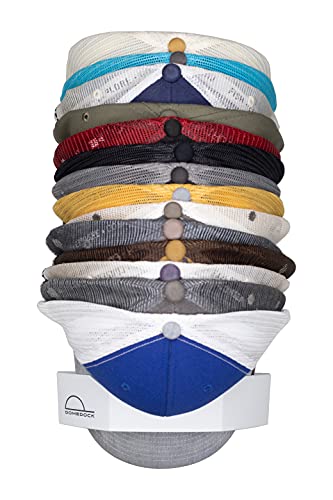
John explained that his growing hat collection had become a mess. Hanging them on doors didn’t work because they fell off. Stacking them on shelves wasn’t practical either.
Hats took up too much space and often collapsed into a pile. He needed a better way. That led him to create DomeDock, a filing system for hats that keeps them organized and easy to grab.
Chelsea demonstrated how users can stack their hats neatly, lift the pile to grab one, and keep everything in place.
The sharks showed immediate interest. Kevin O’Leary said it was an ingenious idea but questioned their $2 million valuation for a piece of plastic.
Since 2019, they have generated $7.5 million in total revenue. The sharks were surprised to hear this. Each DomeDock retails for $24.99 and costs $2.91 to manufacture.
John and Chelsea stated that they initially sold through their own website, but later switched to Amazon for convenience.
While this eliminated the hassle of shipping and logistics, it also meant giving up a portion of their profits.
Mark Cuban asked about their net profit, and John estimated they would end the year with 15% profit after paying themselves.
Robert Herjavec then requested a breakdown of sales over the years.
John shared that in 2019, they made $136,000. By 2020, their website launch helped push sales close to $1 million. The momentum continued, with $1.4 million in 2021, $2.1 million in 2022, and $2.08 million in 2023.
Year-to-date sales were $885,000, and they projected to close the year between $1.4 – $1.5 million. This shift in numbers immediately raised concerns.
The sharks wanted to know why sales had declined. Chelsea hesitated before admitting the issue, unsurprisingly, it was knockoffs flooding the market.
John quickly assured them that they were actively fighting back. Their utility patent allowed them to report counterfeit listings, and so far, they had successfully taken down over 100 infringing products.
However, Daymond John remained doubtful. Drawing from his own experience with FUBU, he pointed out that counterfeiters often outpace the original brand in sales.
Mark explained that while he admired their success, he didn’t see the business growing large enough to be worth his time. He exited the negotiations.
Robert followed, stating that while he respected their hustle, DomeDock was ultimately a single-SKU product with limited expansion potential.
Kevin, however, offered a different perspective. Instead of fighting counterfeiters, he advised them to create their own knockoff version under a different brand.
By pricing it competitively, they could dominate their own market rather than constantly chasing legal battles. Although he admired their journey, he decided not to invest.
Lori Greiner liked the product, but she wasn’t willing to take on the constant battle against knockoffs, so she also opted out.
Daymond saw potential but needed a bigger stake to justify his involvement. He offered $100,000 for 25% equity.
John countered, proposing $100,000 for 10% equity. Daymond declined but adjusted his offer to 20%.
Before they could respond, Kevin jumped back in, offering $100,000 for 15% equity.
Chelsea wanted to know what each shark would bring to the table. Kevin explained his two-step plan.
First, they would launch a budget-friendly knockoff version under a different name. Second, they would secure a national distributor to expand their retail presence.
After weighing their options, John and Chelsea accepted Kevin’s offer.
Now, let’s check in for a DomeDock update.
Shark Tank DomeDock Update
Our DomeDock update found that as part of their
DomeDock remains committed to quality and customer satisfaction, as reflected in their thousands of 5-star reviews from happy customers.
The product is designed and made in Texas, underscoring the company’s dedication to supporting local manufacturing.
Products can be found on the DomeDock website and on Amazon.
We will let you know once we receive another DomeDock update.
For more updates from
Before you go, be sure to check out our list of all the Shark Tank Season 16 products.

Marvin Uzor
Marvin Uzor is a content contributor for Shark Tank Recap. He specializes in crafting engaging, well-researched content that delve into the latest Shark Tank stories, keeping readers hooked. He has a soft spot for his favorite Shark Tank companies, Bombas and Doorbot, known for their innovation and impact.